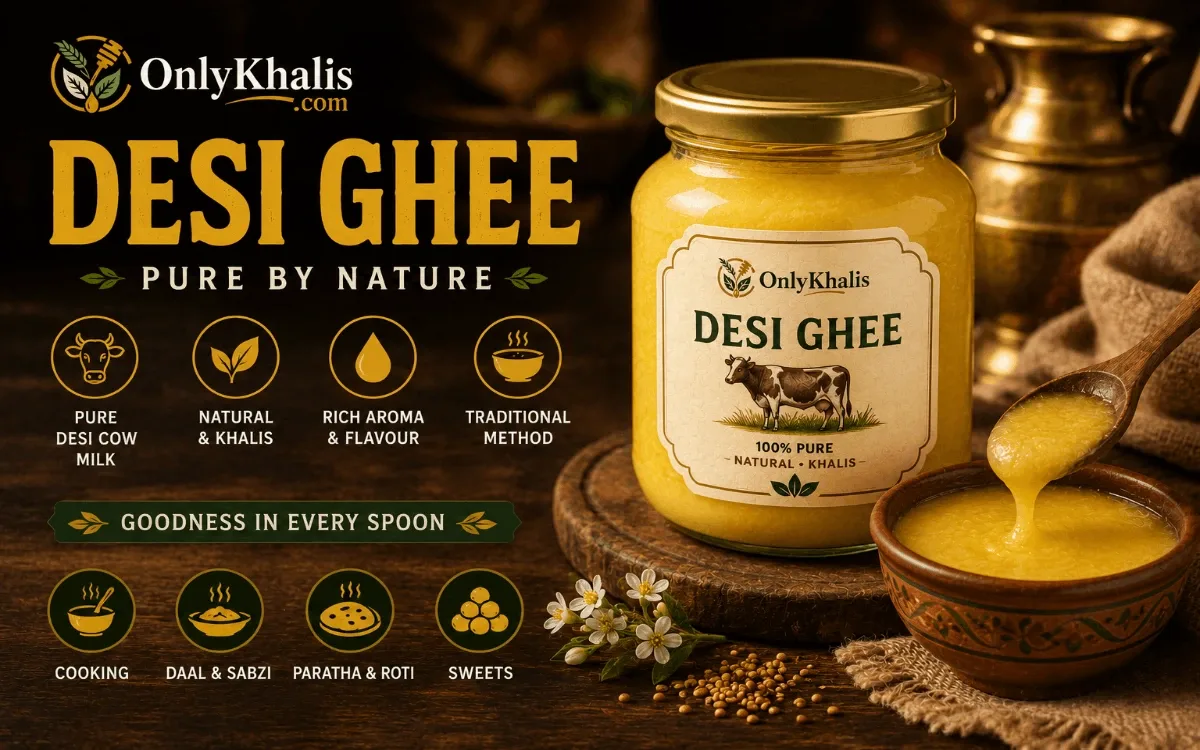
What Is Pure Desi Ghee and Why Does It Matter?
Pure desi ghee has been a cornerstone of Pakistani and South Asian cooking for thousands of years. But walk into any supermarket today and you will find shelf after shelf of products claiming to be "pure" — most of which contain hydrogenated oils, vanaspati, or synthetic flavouring.
Real desi ghee is made from the milk of grass-fed desi cows or buffaloes, churned using the traditional bilona method and slow-cooked until golden. The result is a product with a completely different taste, smell, and nutritional profile from anything you can buy commercially.
Here are 5 tests you can do right now to check if your ghee is genuinely pure.
Test 1: The Refrigerator Test
Put a small amount of ghee in a glass jar and place it in the fridge for 30 minutes.
Pure desi ghee: Sets into a single solid mass with a consistent granular or grainy texture. The colour will be creamy yellow to deep golden.
Adulterated ghee: Often separates into layers — a white layer on the bottom and a yellowish layer on top. This separation indicates the presence of vegetable oils or vanaspati.
This is the single most reliable home test and takes almost no effort.
Test 2: The Frying Pan Test
Heat a small amount of ghee in a pan over medium heat.
Pure desi ghee: Melts immediately, turns a clear golden colour, and produces a rich, nutty, caramelised aroma. It begins to sizzle gently when heated.
Adulterated ghee: Takes longer to melt, may produce a flat or chemical smell, and the colour may be unusually pale or bright yellow due to artificial colouring.
Pay close attention to the smell. Pure bilona ghee has a depth of aroma that is impossible to fake.
Test 3: The Iodine Test
This test checks if starch or mashed potato has been added — a common low-cost adulterant.
Melt a small amount of ghee and add 2 drops of iodine solution (available at any pharmacy).
Pure desi ghee: The iodine colour (brown-orange) remains unchanged.
Adulterated ghee: The mixture turns purple or blue-black, indicating the presence of starch.
Test 4: The Colour and Grain Test
Look at your ghee at room temperature.
Pure desi ghee: Has a natural grainy or granular texture when semi-solid. The colour ranges from creamy white to deep golden depending on the season and the animal's diet.
Adulterated ghee: Is often artificially coloured to look uniformly golden. The texture is smooth and paste-like rather than grainy.
The grainy texture in pure ghee is actually a sign of quality — it indicates the ghee has been properly churned and slowly cooked.
Test 5: The Palm Test
Place a small amount of ghee in your palm.
Pure desi ghee: Melts almost immediately from body heat alone, leaving a thin, non-greasy residue with a pleasant smell.
Adulterated ghee: Takes longer to melt, may leave a greasy or oily residue, and often has a flat or slightly chemical smell.
What Is the Bilona Method and Why Does It Matter?
The bilona method is the traditional process of making ghee that has been used in the subcontinent for centuries. The process works like this:
- Fresh milk from desi cows is gently heated and then cooled
- A natural culture is added and the milk is left to set overnight into curd
- The curd is churned using a wooden bilona in a specific circular motion
- The butter that separates is collected
- The butter is slow-cooked on a low flame until the milk solids separate and the clear golden ghee remains
Most commercial ghee skips this entirely — milk cream is directly processed into butter at high temperatures, destroying much of what makes ghee nutritionally valuable.
Why OnlyKhalis Desi Ghee Is Different
At OnlyKhalis, our desi ghee comes from grass-fed cows reared on natural pasture. No hormones, no chemical feed supplements. The ghee is made using the bilona method in small batches and slow-cooked to bring out its natural golden colour and grainy texture.
Try the refrigerator test on your current ghee tonight. Then try it on ours. The difference will be visible.