Ghee, Butter and Oil Are Not Interchangeable
Most Pakistani kitchens keep all three on hand, and most of us reach for whichever is nearest. But ghee, butter and cooking oil behave very differently once the pan gets hot, and picking the wrong one is the reason a karahi tastes flat or a paratha turns out heavy.
This is a straight comparison: what each one actually does, where it wins, and where it does not.
Smoke Point: The Number That Matters Most
Smoke point is the temperature at which a fat starts to break down, smoke and turn bitter. Once a fat passes it, the flavour is ruined and the fat itself degrades.
- Desi ghee: roughly 250°C. The milk solids have been cooked out, so there is nothing left to burn.
- Butter: roughly 150°C. The milk solids and water still present will brown and then burn quickly.
- Refined cooking oil: roughly 200–230°C depending on the oil.
This is why butter burns in a hot tawa and ghee does not. For anything involving high heat — tarka, deep frying, searing meat — ghee has a real, measurable advantage.
Flavour: Where Ghee Is Hard to Replace
Ghee carries a nutty, caramelised aroma that comes from slow-cooking the milk solids before straining them out. That flavour is the backbone of a lot of Pakistani cooking, and it is the one thing oil cannot imitate at any price.
Butter has a fresher, creamier taste but a much milder one, and it disappears under strong spices. Refined oil is deliberately neutral — it is designed to add nothing.
The practical rule: if the dish is meant to taste of the fat, use ghee. If the fat is only there to conduct heat, oil is fine.
Cost Per Use, Not Cost Per Kilo
Ghee looks expensive next to a bottle of cooking oil, and per kilo it is. But the comparison is misleading for two reasons.
First, ghee is more concentrated. A tablespoon of ghee delivers more flavour than three of oil, so most cooks use noticeably less of it.
Second, ghee keeps. Stored properly it lasts months at room temperature without refrigeration, because there is almost no water left in it for bacteria to grow in. Butter spoils in days outside a fridge.
Work out cost per meal rather than cost per kilo and the gap narrows a lot.
Which One for Which Dish
A practical breakdown for a Pakistani kitchen:
- Tarka and bhunai: Ghee. High heat, and the flavour is the whole point.
- Parathas: Ghee. This is the classic use and nothing else comes close.
- Halwa and mithai: Ghee. Traditional recipes are built around it.
- Deep frying pakoras or samosas: Oil. High volume, and you do not want to spend ghee on something the food will not absorb much of.
- Baking cakes and biscuits: Butter. The water content matters for texture.
- Everyday salan on a weeknight: Either. Oil is fine; ghee is better if you have it.
What About Vanaspati?
Vanaspati — often sold as "banaspati ghee" — is hydrogenated vegetable oil, not ghee at all. It is engineered to mimic the texture of ghee at a fraction of the cost, and it is still widely sold across Pakistan.
The naming is the problem. A tin labelled "ghee" in large letters may be vanaspati, with the actual description in much smaller print. Read the ingredients rather than the front of the packaging.
The Short Answer
There is no single winner, and anyone claiming otherwise is selling something. Ghee wins on heat tolerance, flavour and shelf life. Butter wins in baking. Oil wins on price and neutrality when you are frying in volume.
Most Pakistani kitchens genuinely need all three. The mistake is not choosing wrong — it is using one for a job it was never suited to.
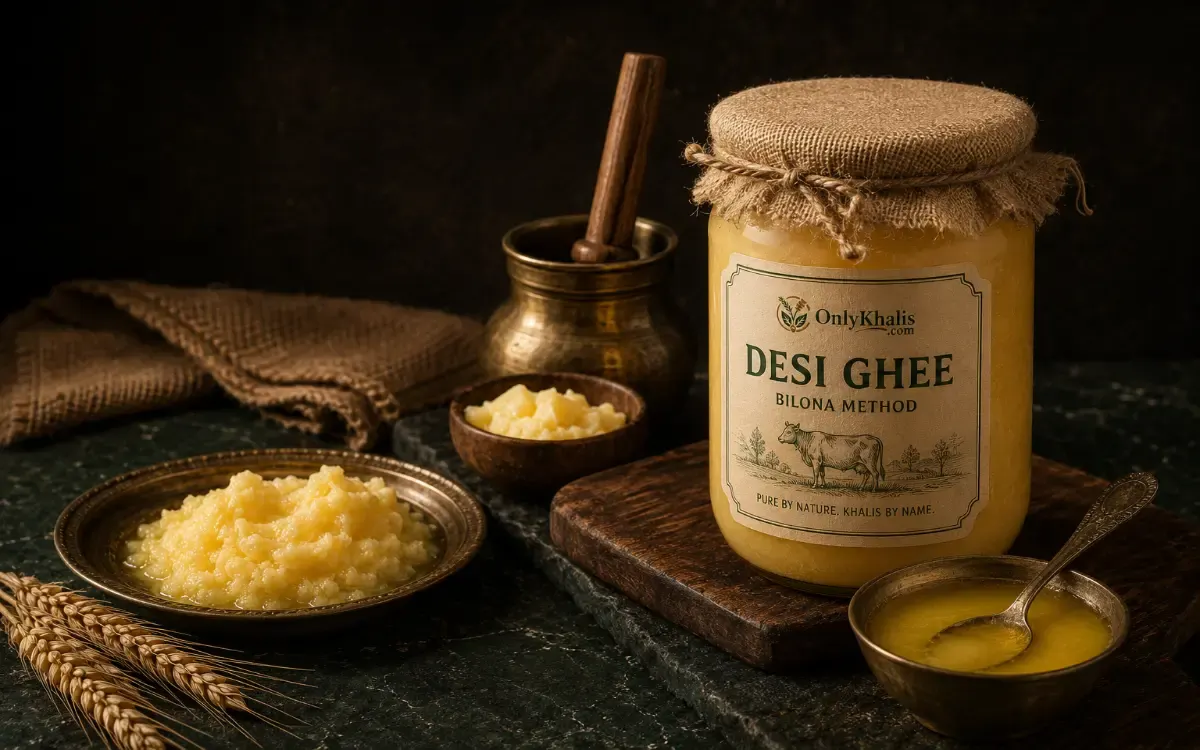
Our desi ghee is made using the bilona method from grass-fed cattle, if you want to taste the difference against whatever is currently in your kitchen.