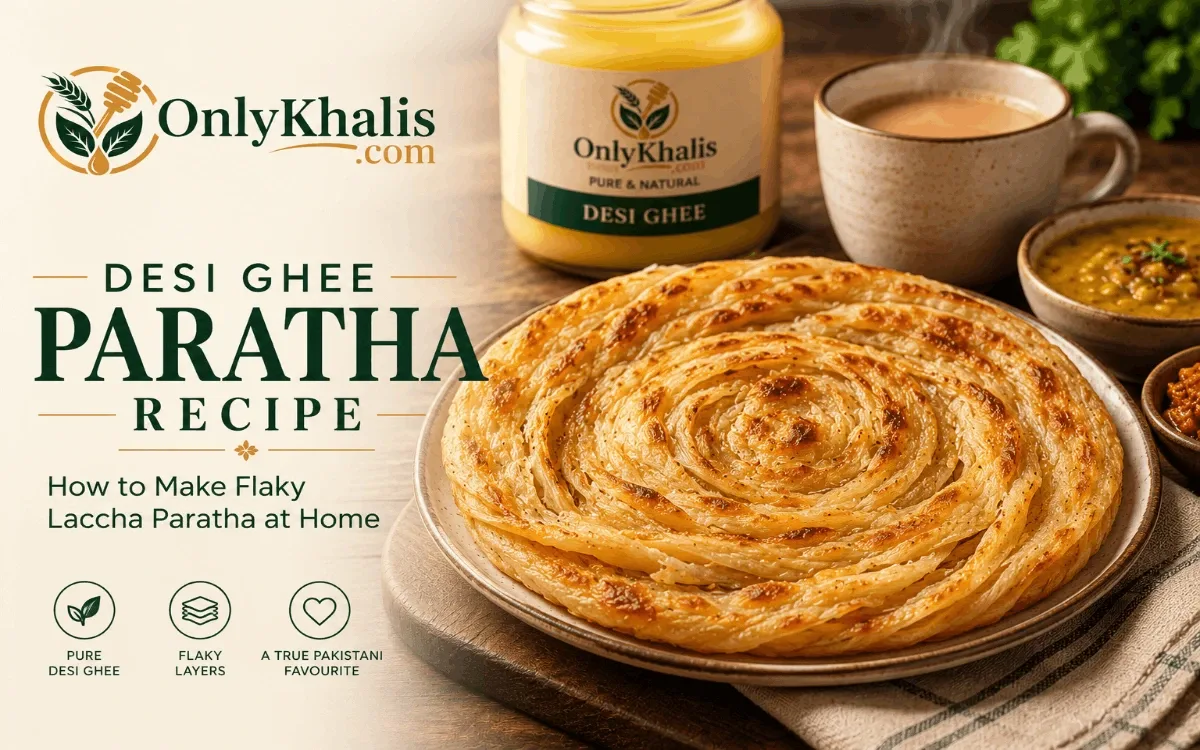
Why Desi Ghee Makes the Best Paratha
A paratha made with pure desi ghee and one made with vegetable oil or vanaspati are genuinely different things. Ghee has a higher smoke point than butter, which means it creates a crispier exterior on the paratha without burning. More importantly, the flavour of pure bilona-method desi ghee comes through in the finished paratha in a way that no other fat can replicate.
Laccha paratha — the flaky, multi-layered version — requires fat between each layer to separate them during cooking. Desi ghee creates cleaner, more defined layers than oil and produces a paratha that is simultaneously crispy on the outside and tender in the layers inside.
What You Need (Makes 4 parathas)
- 2 cups atta (whole wheat flour) or plain flour — or a mix of both
- Water — enough to make a soft, pliable dough (approximately 3/4 cup)
- 1 teaspoon salt
- 4 to 6 tablespoons OnlyKhalis desi ghee — plus extra for cooking
How to Make Laccha Paratha
Step 1: Make the dough
Combine the flour and salt in a bowl. Add water gradually, mixing as you go, until you have a soft, smooth dough. The dough should not stick to your hands but should be softer than bread dough — almost tacky. Knead for 5 to 7 minutes until smooth and elastic. Cover with a damp cloth and let it rest for at least 20 minutes. This resting step is important — it relaxes the gluten and makes the dough much easier to roll out thinly.
Step 2: Divide and roll
Divide the rested dough into 4 equal balls. Take one ball and roll it out on a lightly floured surface into a thin circle — as thin as you can manage without tearing, roughly the size of a dinner plate.
Step 3: The layering technique
This is what creates the laccha (layered) texture. Spread approximately 1 tablespoon of soft desi ghee evenly over the entire surface of the rolled circle. Then sprinkle a very small amount of dry flour over the ghee — just enough to lightly dust the surface.
Now fold the circle like a fan — make parallel folds of about 1.5 to 2 cm width, accordion-style, from one edge to the other. You will end up with a long strip of folded dough.
Take this strip and coil it tightly into a round spiral, tucking the end underneath. Press gently to flatten slightly. This is your layered dough ball.
Step 4: Second roll
Take the coiled spiral and roll it out again into a circle, this time to the thickness of a normal paratha — roughly 3 to 4 mm. Roll gently and evenly. You will see the layers beginning to show in the dough as you roll. Do not press too hard or the layers will fuse together.
Step 5: Cook
Heat a tawa or flat pan on medium-high heat. When hot, place the rolled paratha on the dry tawa. After 60 to 90 seconds, when the surface begins to look dry and small bubbles appear, flip the paratha.
On the second side, add approximately half a teaspoon of desi ghee around the edges and on top of the paratha. Spread gently. Flip again and add ghee to the other side. Press lightly with a spatula on any thick areas to ensure even cooking.
Cook until both sides are golden brown with darker spots — the characteristic colour of a properly cooked paratha. The total cooking time on the tawa is usually 3 to 4 minutes.
Step 6: Crush and serve
This final step is important for laccha paratha. When the paratha comes off the tawa, immediately hold it between your two palms and gently crush and press it several times. This motion separates the layers and creates the characteristic laccha texture — flaky, separated layers rather than a solid flat bread.
Serve immediately. Laccha paratha is best eaten hot off the tawa.
What to Serve With Desi Ghee Paratha
- Daal: The classic pairing — any daal works but mash ki daal or chana daal with a ghee tarka is particularly good
- Anda (egg): A simple fried or scrambled egg with the yolk still runny, cooked in desi ghee
- Achar: Any good Pakistani pickle cuts through the richness of the ghee beautifully
- Chai: For a traditional Pakistani breakfast — hot sweet chai with a ghee paratha is one of the finest simple meals there is
Why This Recipe Works Best With Pure Desi Ghee
The ghee in this recipe is not a flavouring — it is a structural ingredient. It is what creates the layers, prevents them from fusing together during cooking, and produces the crispy exterior. The quality of the ghee directly affects the quality of the paratha.
Pure bilona-method desi ghee, with its natural fat composition and slightly granular texture at room temperature, spreads differently than commercial ghee and creates cleaner layers. The flavour it imparts to the finished paratha — subtle, nutty, deeply satisfying — is something that vegetable ghee or oil simply cannot replicate.