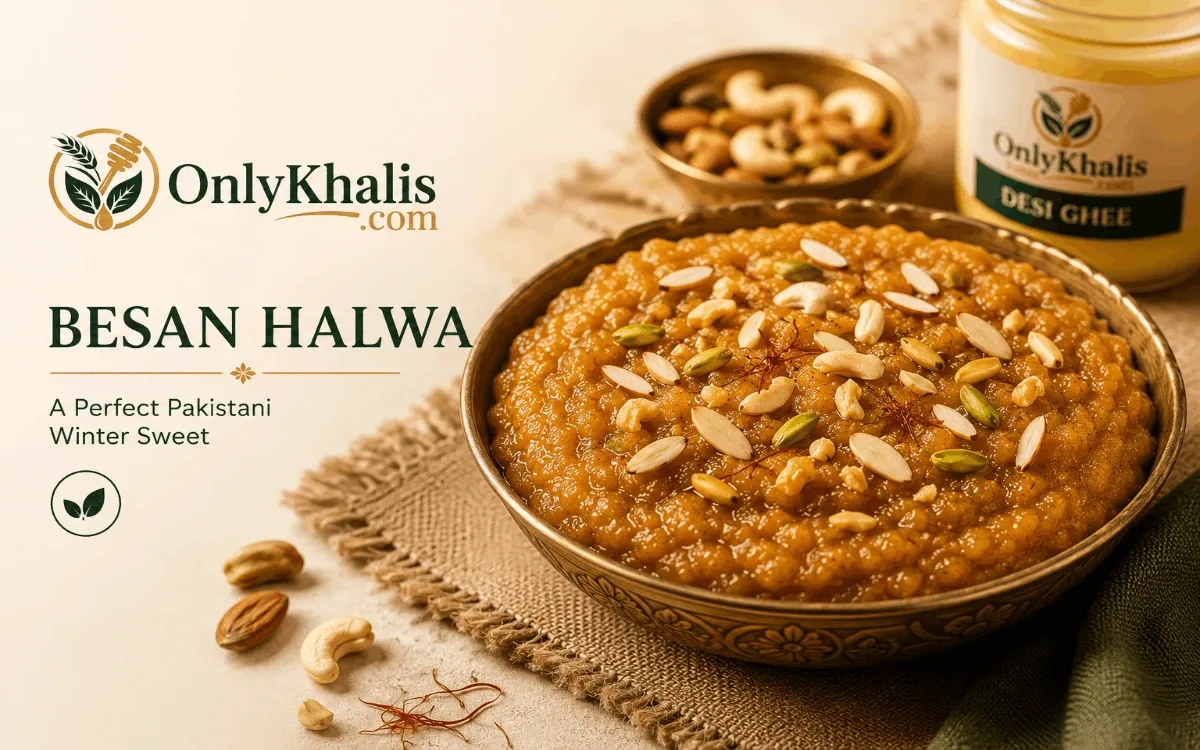
Why Besan Halwa Is Special
Besan halwa occupies a unique place in Pakistani food culture. Unlike other sweets that rely on sugar for their flavour, besan halwa gets its character entirely from the slow roasting of gram flour in ghee — a process that produces one of the most satisfying aromas in all of cooking. When done right, the smell of besan roasting in desi ghee fills the entire house.
The quality of the besan matters enormously here. Stone-ground besan roasts differently from commercial mill-ground flour — the natural oils in the chickpeas caramelise slowly and produce a much deeper, nuttier flavour. This is one recipe where the difference between pure and commercial ingredients is immediately obvious in the final result.
What You Need (Serves 4)
- 1 cup OnlyKhalis besan (gram flour)
- 3/4 cup OnlyKhalis desi ghee
- 3/4 cup sugar
- 2 cups water
- 1/4 teaspoon cardamom powder (elaichi)
- A small handful of mixed nuts for garnish (almonds, pistachios, cashews)
- Optional: a few strands of kesar (saffron) dissolved in 1 tablespoon warm milk
How to Make Besan Halwa
Step 1: Make the sugar syrup
In a separate saucepan, combine the water and sugar. Bring to a gentle boil over medium heat, stirring until the sugar is completely dissolved. Add the cardamom powder and stir. If using saffron, add the dissolved saffron now. Keep the syrup warm on a low flame while you roast the besan.
Step 2: Roast the besan in ghee
This is the most important step and requires patience. Melt the desi ghee in a heavy-bottomed pan — a karahi or a thick saucepan works best — over medium-low heat. Add the besan all at once and stir immediately to combine with the ghee.
Continue stirring constantly over a medium-low flame. The mixture will first look pale and raw. After 10 to 12 minutes of continuous stirring, it will begin to darken to a golden colour and the raw flour smell will give way to a deep, nutty, caramelised aroma. This is the moment you are waiting for.
Do not rush this step by increasing the heat. High heat will burn the besan on the outside while leaving it raw inside. Low and slow is the only way to develop the full flavour.
Step 3: Add the syrup
When the besan is a deep golden colour and smells richly nutty, carefully pour in the warm sugar syrup. Stand back slightly — the mixture will bubble and splutter vigorously when the liquid hits the hot ghee mixture. Stir quickly and continuously to combine everything smoothly.
Continue cooking and stirring over medium heat. The halwa will first look very liquid but will thicken rapidly as the besan absorbs the syrup. Keep stirring until the halwa begins to pull away from the sides of the pan and forms a cohesive mass — usually 5 to 7 minutes.
Step 4: Finish and serve
When the halwa has reached a thick, fudge-like consistency and the ghee begins to separate slightly at the edges (a sign it is done), remove from the heat. Transfer to a serving dish and smooth the top with the back of a spoon. Garnish generously with sliced almonds, pistachios, and cashews.
Besan halwa can be served warm straight away or allowed to set and cut into pieces. It keeps well at room temperature for 2 to 3 days and in the fridge for up to a week.
Tips for Perfect Besan Halwa
- Use enough ghee: Besan halwa needs a generous amount of ghee to roast properly. Reducing the ghee saves calories but ruins the texture and flavour
- Keep stirring: Never leave the besan unattended while roasting. It burns quickly and unevenly if you stop stirring
- Warm syrup only: Adding cold syrup to hot besan causes it to seize and go lumpy. Keep the syrup warm
- Taste before serving: Adjust sugar to your preference. Some families prefer it less sweet, which lets the nutty besan flavour come through more strongly
Why This Recipe Tastes Different With OnlyKhalis Besan
If you have made besan halwa before with commercial gram flour and found it flat or slightly bitter, the besan is the reason. Stone-ground besan roasts with a depth and richness that roller-milled flour simply cannot match — because the natural oils that produce that flavour are still intact.
Combined with OnlyKhalis bilona-method desi ghee, this recipe produces a halwa with a flavour that commercial versions cannot replicate.